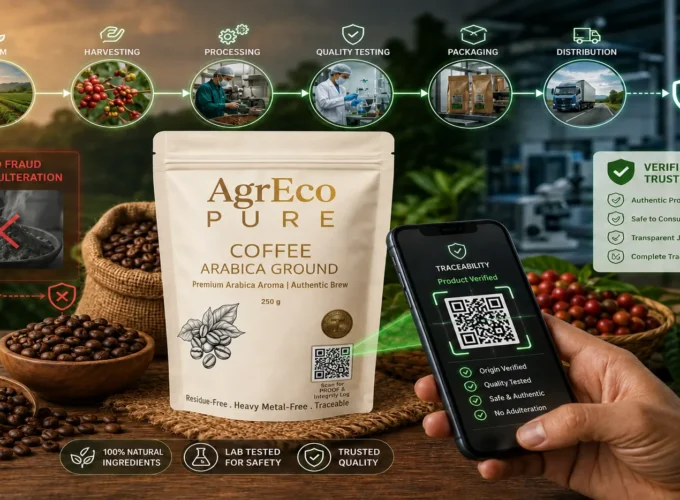
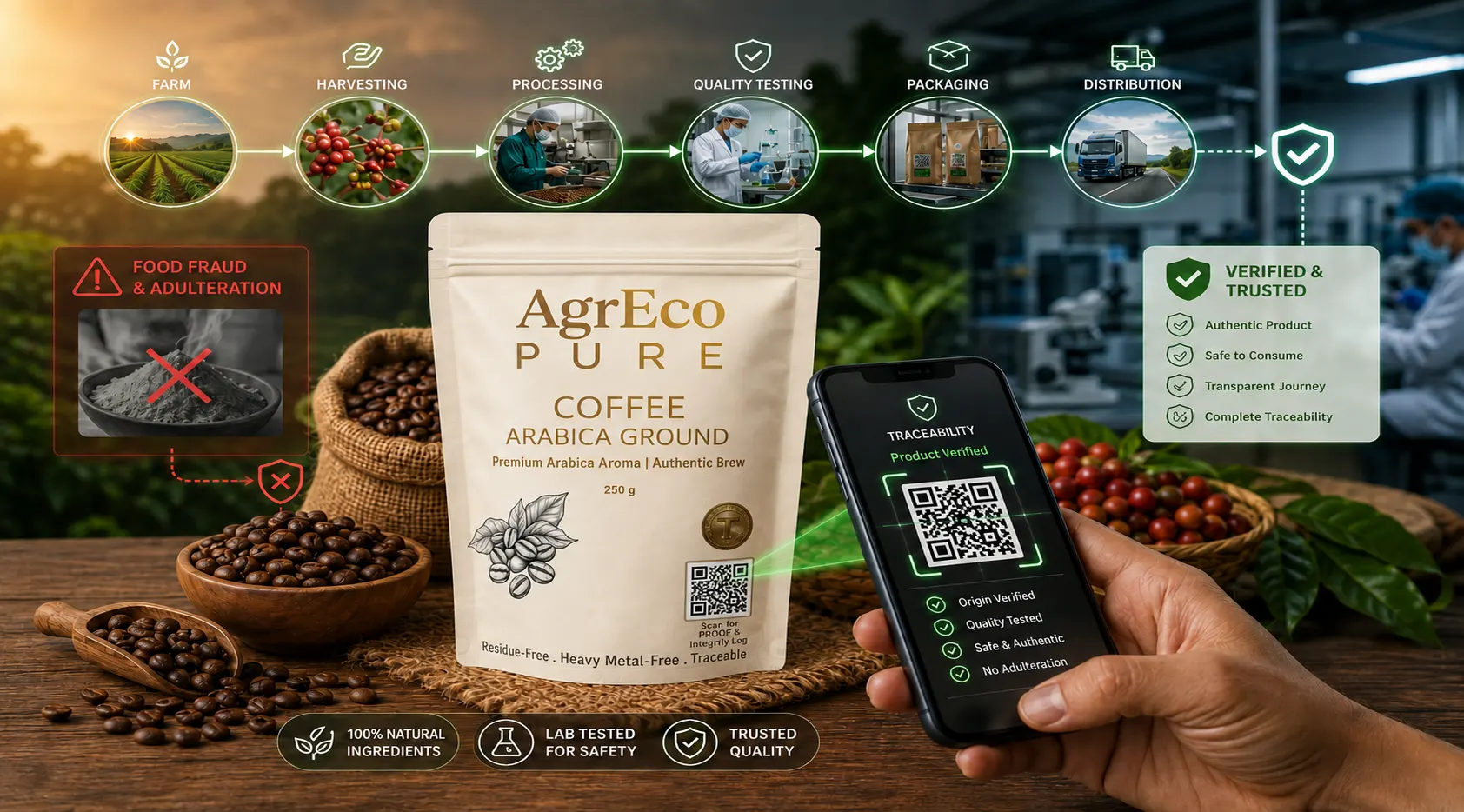
QR-code traceability helps prevent food fraud and adulteration by connecting a food product with digital information about its origin, batch, processing, and supply-chain journey. This makes product information easier to verify and helps businesses trace suspicious or affected products faster.
Today, consumers want more than attractive packaging. They want to know where their food comes from, what is inside it, and whether the product can be trusted. This is where food traceability and QR-code technology can make a difference.
What Is QR-Code Traceability in Food?
QR-code traceability is a digital system that connects a QR code on a food package to information about that product or batch.
When scanned with a smartphone, the QR code may provide information such as:
- Product origin
- Batch or lot number
- Production details
- Processing information
- Packaging details
- Certifications, where applicable
- Supply-chain information
- Product authenticity information
The information available depends on how the food company has designed its traceability system.
The broader move toward digital food traceability is also recognized by the U.S. Food and Drug Administration (FDA). Its New Era of Smarter Food Safety initiative identifies tech-enabled traceability as one of four core elements for building a safer and more digital food system.
How Does QR-Code Traceability Prevent Food Fraud?
QR-code traceability helps reduce opportunities for food fraud by creating a digital information trail that can be connected to a product or batch.
Food fraud can involve substituting ingredients, removing valuable ingredients, or adding substances to make a food appear more valuable. The FDA describes economically motivated adulteration as including intentional substitution or addition designed to deceive consumers.
QR-code traceability can help address this problem in several ways.
1. It Gives Food Products a Digital Identity
A traceability system can assign a product or batch a unique digital identity.
Instead of relying only on printed information, businesses can connect that identity to supply-chain records.
For example, imagine a packet of premium black pepper.
Its digital record could be connected to:
Source → Processing → Quality Check → Packaging → Distribution → Retail
If the information is properly maintained, this creates a clearer trail showing how the product moved through the supply chain.
2. It Improves Food Supply-Chain Transparency
Food can pass through many hands before reaching consumers.
A typical food supply chain may include:
Farmer → Processor → Manufacturer → Distributor → Retailer → Consumer
When information is scattered across different records, tracing a product can take time.
Digital traceability can connect important information from different stages. This can make it easier for businesses to understand where a product came from and where it went.
The FDA’s tech-enabled traceability approach focuses on rapidly identifying sources and supporting faster removal of potentially contaminated products when necessary.
3. It Helps Verify Product Information
One of the biggest advantages of a QR code is that it can connect physical packaging with digital information.
Consumers or businesses can check whether the information shown after scanning is consistent with the product label.
For example, they may be able to compare:
- Product name
- Batch number
- Origin
- Production information
- Packaging details
If important information does not match, it may be a reason to investigate the product further.
This makes QR codes a useful verification layer, although they should not be treated as proof of authenticity by themselves.
4. It Makes Batch Tracking Easier
Food traceability becomes especially important when a quality or safety problem is discovered.
If products are connected to specific batches, a company may be able to identify which products are affected instead of investigating its entire product range.
This can help businesses:
- Identify affected batches
- Trace products through distribution
- Investigate the source of a problem
- Support targeted recalls
- Reduce unnecessary waste
The FDA’s traceability framework is designed to support faster and more accurate identification of food through the supply chain.
Can QR Codes Detect Food Adulteration?
No, a QR code cannot directly detect food adulteration.
A QR code stores or connects users to information. It does not chemically test food or identify an adulterant.
However, QR-code traceability can help with verification and investigation.
For example, if a product claims to contain a particular ingredient or come from a particular source, its traceability records can provide supporting information about that claim.
Actual detection of adulteration may require appropriate laboratory testing, inspections, documentation, or other quality-control methods.
So, the better way to think about QR codes is:
QR code = traceability and information
Testing and quality controls = verification of food safety and composition
Both can work together.
How Do QR Codes Help Prevent Food Fraud?
QR codes can support food fraud prevention by making supply-chain information easier to connect, review, and verify.
Here is a simple example:
A food company purchases raw spices from a supplier.
The raw material receives a batch identity.
↓
The ingredient is processed and quality-checked.
↓
The finished product receives its packaging and QR code.
↓
The product moves to distribution.
↓
A consumer scans the QR code.
↓
The consumer can access available product information.
If the records are accurate and properly controlled, this creates a traceability trail that can make unexplained changes or inconsistencies easier to investigate.
QR Code Traceability vs Traditional Food Tracking
| Feature | Traditional Tracking | QR-Code Traceability |
| Product information | Often stored in physical or separate records | Can be connected to digital information |
| Consumer access | Usually limited | Information can be accessed by scanning |
| Batch tracking | Possible through records | Can be linked directly to a digital identity |
| Supply-chain visibility | May be fragmented | Can create a connected information trail |
| Verification | Often manual | Can provide faster digital access |
| Recall support | May require searching multiple records | Digital records can support faster tracing |
| Transparency | Depends on available records | Can make selected information easier to access |
What Information Can a Food QR Code Show?
A food QR code can potentially provide:
- Product origin
- Batch or lot information
- Manufacturing details
- Processing information
- Packaging date or related information
- Ingredient information
- Certifications
- Quality information
- Distribution details
- Product authenticity information
However, not every QR code contains all of these details.
The usefulness of a QR code depends on the quality, accuracy, and completeness of the information behind it.
Can QR Codes Completely Stop Food Fraud?
No. QR codes cannot eliminate food fraud or adulteration.
This is one of the most important limitations to understand.
A QR code is only as reliable as the system behind it. If incorrect or misleading information is entered into a traceability database, scanning the QR code will not automatically expose the problem.
Effective food fraud prevention requires multiple layers, including:
- Reliable suppliers
- Accurate records
- Quality-control procedures
- Product testing where appropriate
- Secure data management
- Supply-chain monitoring
- Proper food-safety practices
- Effective traceability systems
The FDA also emphasizes that smarter food safety involves more than technology; it combines technology with modern processes and food-safety culture.
How Can Consumers Use QR Codes to Check Food Products?
Consumers can use QR codes as one part of their food-buying checks.
Before purchasing a product, scan the code and look for useful information.
Ask:
1. Where does the product come from?
Check whether the available origin information is clear.
2. Does the batch information match the package?
Look for consistency between the physical label and digital information.
3. Is the product information detailed?
A useful traceability page should provide meaningful product information rather than only promotional content.
4. Does anything look inconsistent?
Unusual or conflicting information deserves additional attention.
5. Can the brand explain its sourcing and quality process?
Transparency from the food company can provide additional confidence.
Consumers should still check the ingredient list, packaging, expiry information, food-safety details, and other applicable labels.
Why Is Food Traceability Important for Food Brands?
For food brands, traceability is more than a technology feature.
It can help businesses understand their supply chains, respond to problems, and provide consumers with clearer information.
Good traceability can help a company answer important questions such as:
- Where did this product come from?
- Which supplier provided the ingredient?
- Which batch was used?
- Where was the product distributed?
- Which products may be affected if a problem is found?
The FDA’s goal of end-to-end traceability reflects the importance of being able to follow food through the supply chain and identify sources more quickly.
At AgrEco Pure, we use transparent sourcing and traceability practices, which that can help consumers better understand the journey behind the products they purchase.
What Are the Main Benefits of QR-Code Traceability?
The main benefits of QR code traceability include:
- Greater food transparency
- Better batch identification
- Improved supply-chain visibility
- Easier product verification
- Faster access to product information
- Better recall support
- Stronger accountability
- Greater consumer confidence
These benefits make digital traceability an increasingly useful part of modern food systems.
What Makes QR-Code Traceability Effective?
A QR-code system is most useful when it is supported by reliable data and strong processes.
A simple formula is:
QR code + accurate data + reliable records + quality controls = stronger traceability
The QR code is simply the connection between the physical product and the digital information.
The real value comes from what happens behind that code.
Frequently Asked Questions
What is QR code traceability?
QR-code traceability connects a food product or batch to digital information about its origin, processing, production, packaging, or supply-chain journey.
How does QR-code traceability prevent food fraud?
It can help prevent and investigate food fraud by connecting products with traceability records, making product information easier to verify, and improving visibility across the supply chain.
Can QR codes detect adulterated food?
No. QR codes cannot chemically detect adulteration. They provide traceability and product information, while laboratory testing and quality-control procedures may be needed to identify adulteration.
Why is food traceability important?
Food traceability helps businesses identify where products came from and where they moved through the supply chain. It can support investigations, recalls, and faster responses to food-safety problems.
What can consumers learn by scanning a food QR code?
Depending on the system, consumers may see information about product origin, batch number, processing, ingredients, certifications, quality information, or supply-chain details.
Can QR-code traceability improve consumer trust?
Yes. When QR codes provide useful and accurate product information, they can make a brand’s sourcing and supply-chain information more transparent and easier for consumers to access.
Final Thoughts
QR-code traceability is becoming an important tool for improving food transparency and supply-chain visibility.
It can give food products a digital identity, connect them with batch and sourcing information, and make important records easier to access. These capabilities can support food fraud prevention, product verification, investigations, and recall management.
However, a QR code is not a replacement for food testing, quality control, supplier verification, or food-safety practices.
Its real strength comes from the trustworthy information behind it.
As food supply chains become more digital, combining QR-code traceability, accurate data, strong quality controls, and transparent sourcing can help create a food system where businesses have better visibility, and consumers have more information about what they buy.